
PR Times: Suzuka Circuit Selected as Finalist for the Sport Positive Awards 2025, an International Award Recognizing Sustainability Activities in the Sports World
Suzuka Circuit, operated by Honda Mobility Land Co., Ltd. (Headquarters: Suzuka City, Mie Prefecture; President and CEO: Tsuyoshi Saito), has been recognized for its sustainability initiatives at the Formula 1 Japanese Grand Prix and has been selected as a finalist in the Transformation category of the Sport Positive Awards 2025, an international award that recognizes sustainability initiatives in the world of sports.
The Sport Positive Awards are international sustainability awards that recognize organizations and individuals who use the power of sport to address global challenges such as climate change, the biodiversity crisis, and environmental and climate justice.
More than 100 organizations and individuals from around the world have been selected as finalists in each category, including international sports organizations and teams such as the FIS (International Ski Federation), the NBA (National Basketball Association), and Premier League soccer clubs Tottenham Hotspur, Liverpool FC, Manchester City, and Arsenal FC.
The “Transformation” category, in which Suzuka Circuit was a finalist, recognizes organizations that have strategically strengthened their sustainability efforts in recent years and accelerated their response to climate change and the biodiversity crisis.
The awards will be announced at the Sport Positive Summit (October 7, 2025, London, UK), which will bring together sports organizations, leagues, and event organizers from around the world in collaboration with the International Olympic Committee (IOC) and the United Nations Framework Convention on Climate Change (UNFCCC).
[Reference] Sport Positive Awards 2025 official website
Initiatives at the F1 Japanese Grand Prix
The F1 Japanese Grand Prix, which was held at Suzuka Circuit in April 2025 and attracted 266,000 visitors, achieved zero greenhouse gas emissions (Scope 1 and Scope 2) through measures such as self-generating electricity using solar panels on-site and increasing the proportion of biofuels in the paddock area from 16% the previous year to 100%.
Additionally, by separating waste collection, we have achieved zero landfill waste, and by expanding the number of direct tour buses, we have increased the number of visitors using low-carbon transportation from 60.5% last year to 64.4%.
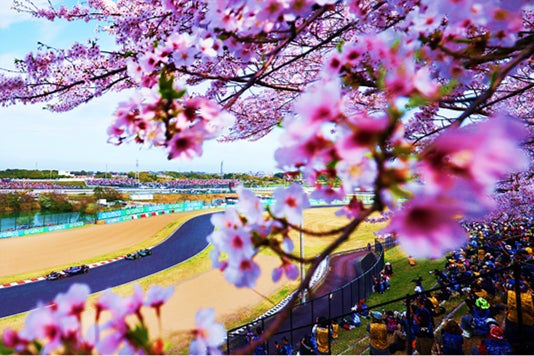
Furthermore, these large-scale events are positioned as “demonstration fields for solving social issues,” providing businesses and local governments with opportunities to demonstrate new solutions. Self-power generation using solar panels on the premises was made possible through a partnership with Tess Engineering Co., Ltd., and beverages were served in reusable aluminum cups in partnership with UACJ Corporation.
In addition, Suzuka Circuit will supply the grid electricity used for motorsport events, not just the F1 Japanese Grand Prix, with CO2-free green electricity from 2022, and will achieve zero disposable plastics in food and drink-related activities from 2023.
Suzuka Circuit will continue to work towards carbon neutral motorsport events, and will also work to address global environmental and social issues in spectator sports and the industry as a whole, contributing to creating a sustainable future.
[Reference information]
<Honda Mobilityland’s Basic Sustainability Policy>
Honda Mobilityland’s basic sustainability policy is to “foster a mobility culture, promote motorsports, and utilize its practical fields of human resource development to address global environmental and social issues and contribute to creating a sustainable future.”
Furthermore, we are promoting the reduction of greenhouse gas emissions by expanding the use of clean energy, reducing waste generation, and promoting recycling, with the aim of achieving carbon neutrality at major motorsport events by 2030.
Honda Mobilityland Sustainability

<Suzuka Circuit’s Sustainability Activities>
| Categories | Initiatives at the F1 Japanese Grand Prix |
| waste | – All food and drink is served in biomass or returnable containers, eliminating the use of single-use plastic.- Thoroughly separate waste into nine categories, increase the ratio of material recycling and composting, and implement upcycling and resource circulation.Approximately 132 tons of waste will be generated during the F1 Japanese Grand Prix, but by separating and collecting the waste, no waste will be sent to landfills, and the recycling rate will be 46.1% (up 4.6 points from last year). |
| Fan movement | ・Five more direct tour buses from domestic tourist hubs and stations were added since last year, expanding capacity to a total of 350 vehicles and 14,000 passengers, improving the low-carbon travel rate to 64.4% (up 3.9 points from last year). |
| Well-being | ・15 free water stations will be installed within the venue, reducing the use of 16,000 plastic bottles (500ml equivalent).- To meet diversifying food and beverage needs, 50 stores offer vegetarian menus.- 400 wheelchair seats are provided. |
| Regional Cooperation | – A plan was implemented to invite approximately 4,000 families from the surrounding area to the Thursday and Friday of the F1 Japanese Grand Prix.・Provided an opportunity for 30 elementary school students in Suzuka City to interact with F1 drivers.・We accepted internships (24 students) as an opportunity for students to practice global communication.- Surplus food was collected and approximately 7.8 tons was donated to 14 food banks managed by Mie Prefecture. |
| Energy | ・45% of the electricity used on the racing course is generated in-house by a solar carport in the parking lot.・Grid power uses CO2-free green electricity.All generators in the paddock area are now powered by HVO fuel (biofuel), achieving a 100% ratio. |
| Greenhouse gas (CO2) | ・Scope 1 (direct emissions): The HVO fuel ratio for the entire facility is 85%, so the remaining 15% is offset with carbon credits, achieving zero CO2 emissions.・Scope 2 (indirect emissions): Achieve zero CO2 emissions from 2022 by using CO2-free electricity. |
<Suzuka Circuit Sustainability Partners> Company name: Initiatives (in alphabetical order)
Adish Plus Co., Ltd.: Reducing CO2 emissions associated with fan travel through the use of a private carpooling service
・Coca-Cola Bottlers Japan Inc.: Horizontal recycling of PET bottles
・JTB Corporation: Expanding low-carbon transportation options for fans attending the event
・Tess Engineering Co., Ltd.: Renewable energy supply through solar panels
・Pieclex Co., Ltd.: Providing compostable staff uniforms for the Coca-Cola Suzuka 8 Hours Endurance Race
・Mitsubishi Research Institute, Inc.: Consulting support for promoting sustainability initiatives
・UACJ Corporation: Providing reusable aluminum returnable cups
・Raksul Co., Ltd.: Reducing waste by reducing excess inventory
(As of August 2025)
We are also looking for new partners
Honda Mobility Land and Suzuka Circuit are looking for partner companies that share our sustainability vision and want to build the future together.
We welcome co-creation in a wide range of fields, including renewable energy, resource recycling, mobility, digital solutions, and improving the fan experience.
If you are interested, please contact us here
Honda Mobility Land Corporate Inquiries
Read the original article in Japanese here.